


In today’s rapidly shifting business landscape, future-proofing your brand isn’t just about staying relevant—it’s about making smart investments that help you solve your business challenges and deliver value over time.
Here’s what we know to be true: brand management is change management. Your brand touches every part of your business. When it’s working well, it makes everything else easier; from hiring to sales to customer retention. But when your brand isn’t working—when it feels disconnected from your business reality, when it’s not driving the results you need, when it’s holding you back instead of propelling you forward—that’s when you know change needs to happen.
Read below to understand:
Current business challenges (and why they are making it harder for businesses to buy in)
When it comes to securing internal buy-in for brand investments, here are the top challenges we’re hearing:
- We are in a period of rapid transformation. Companies are struggling with brand consistency due to evolving business realities, including post-pandemic reorganization, decentralization to centralization, and the impact of AI in the marketplace. On top of this, leadership teams face pressure to deliver instant financial impact when brand investment creates value over time. Many companies are playing the “wait-and-see” game to find out how the landscape settles.
- Brand fatigue is real. After years of “revolutionary” announcements, “game-changing” platforms, and “transformative” solutions, audiences have developed immunity to hyperbolic brand positioning. Additionally, marketing budgets have been under scrutiny for a while, and brand work often competes with performance marketing efforts that show more direct results. This has translated into brands not evolving over time.
- Customers expect cohesive brand experiences. Companies are operating across more channels than ever before, making brand consistency even more difficult to achieve. Audiences struggle to recognize and trust brands when their external experience with the company is fragmented.
- Change is happening faster than brands are able to adapt. Internal teams are challenged by budget and resource constraints, organizational inertia and siloes, and information overload, all in a time when short-term demands take priority over long-term strategic efforts. Post-pandemic operational shifts, remote teams, and changing customer expectations still continue to create organizational complexity.
Shifting the perspective on brand investment
CMOs and Brand Managers are navigating unprecedented business complexity while pressure mounts to show immediate ROI. This challenge feels overwhelming: budget constraints, competing priorities, and the constant pressure to deliver instant results, all with the understanding that investing in their brand creates value over time.
According to EMARKETER, 45.5% of B2B marketers would allocate over half their marketing budget to brand building if budgets weren’t a barrier. This proves that brand value recognition within marketing teams still exists, and the desire is still there to make strategic investments.
What if they could shift the perspective and make brand a value driver for their company? Instead of treating brand as a single marketing expense, fighting for budget amidst all the competing demands, it’s viewed as part of the business’s infrastructure and an investment in the foundation that makes every other initiative stronger.
Consider these findings to help validate this approach:
- Strong brands outperform the market by 73%, according to McKinsey—but only when systematic execution matches strategic vision
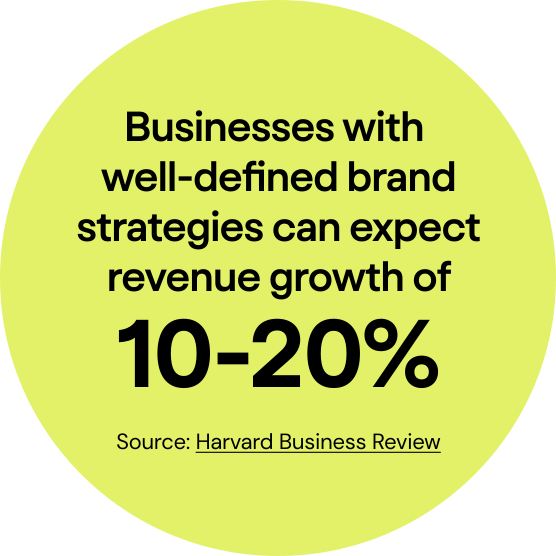
- Consistent brand presentation across all platforms can increase revenue by up to 10-20%, according to G2.
- 77% of marketing leaders say strong brand is critical to growth plans, according to Linearity
Companies that invest in the time and effort to build a solid brand create a lasting competitive advantage that can’t be easily replicated. While the system framework itself can be copied, your unique brand foundation, messaging, and positioning are 100% yours. The successful companies are ones that have the strongest and authentic brand design systems, not only the most striking creative.
Where to focus
We’ve narrowed down the four strategic investment areas with the most potential to future-proof your brand. We’ve also outlined how these investments can create immediate value and build long-term resilience within your company.

Gain clarity and direction through a solid brand foundation
A comprehensive brand framework includes your company’s core components: your mission, vision, purpose, core values, brand promise, brand positioning, brand architecture, tone of voice, brand messaging, and key pillars. When you have a solid brand framework, it becomes the invisible foundation of everything your company produces. The decisions you make around that foundation inform your efforts in marketing, sales, product, events, human resources, customer interactions, vendor relationships, and more.
Most companies benefit from investing in a comprehensive foundational brand framework review every 3-5 years as a best practice, even without major triggers, to ensure continued relevance and effectiveness. This is especially recommended when they are experiencing business evolution and growth, market disruption and competitive shifts, leadership changes, shifts in their target audiences, and mergers, acquisitions, or restructuring.
Invest here if you need to:
- Understand your differentiation and position in the market
- Build customer trust and emotional connection
- Reduce decision cycles and speed up project approvals
- Align cross-functional teams around shared objectives
- Improve efficiency across the organization
- Create consistent internal and external communications
- Build organizational capability that adapts to market changes

Refresh your visual identity and connect with your customers
Your visual identity consists of your logo system, color palette, typography, image library, core design elements and patterns, and a brand guidelines document outlining how to use and apply the brand effectively. When these elements are used consistently, customers instantly recognize your brand and makes it memorable in seconds.
Most companies benefit from investing in a comprehensive visual identity update every 5-7 years as a best practice. This is especially recommended with a brand strategy exercise when they are experiencing business evolution and growth, market repositioning, and mergers, acquisitions, or restructuring. Other reasons for investing in visual identity updates include brand fatigue, company maturation, performance issues with the current visual identity, and competitive pressure.
Invest here if you want to:
- Create stronger market differentiation from competitors
- Generate both immediate market recognition and long-term brand equity
- Build stronger customer relationships through authentic brand expression
- Gain credibility and withstand competitive pressure
- Provide internal teams with guidelines to show your brand consistently
- Align your identity with your current product or company demographic


Grow and scale your company with aligned, well-branded assets
Most companies benefit from investing in creative asset alignment in two specific scenarios. One, alignment is especially recommended with a larger brand strategy and/or visual identity exercise when companies experience business evolution and growth, market repositioning, and mergers, acquisitions, or restructuring. Two, a company is experiencing performance issues, market and competitive changes, inconsistency and brand drift, lifecycle and relevancy issues, and leadership or organizational changes that influence all creative assets moving forward.
In either scenario, ensuring that your assets across every customer touchpoint are easy to understand, brand-consistent, and high-quality—no matter how swiftly change is happening—helps reinforce trust in your brand. This includes considering how your brand appears across physical and digital environments.
Invest here if you want to:
- Convey competency and professionalism
- Build customer trust through consistent brand presentation
- Ensure every customer interaction reinforces strategic positioning
- Eliminate constant micro-decisions that slow down team productivity
- Streamline creative production and avoid constant rework
- Create operational efficiency and cost savings across the company


Perform smaller, intentional updates to transform over time
Unlike the other recommendations, all companies should continually invest in maintaining their brand rather than treating it as a set-it-and-forget-it asset post-launch. This is especially recommended as an add-on when a larger brand strategy and/or visual identity exercise has been performed. However, brands can also leverage maintenance cycles to perform smaller, more strategic updates to their brand, messaging, and creative. It’s always important to document these changes within brand guidelines, internal libraries, and/or third-party digital asset management tools so they are current and accessible to everyone.
A good rule of thumb is to check in on your brand annually to assess its overall health, consistency, and effectiveness. More frequent brand assessments can focus on specific elements over time. By monitoring your brand and visual identity’s performance and enforcing it with clear guidance, you can uncover the best opportunities for evolution and growth without the need to invest in a larger refresh.
Invest here if you want to:
- Avoid unnecessary and costly rebranding initiatives
- Maintain brand recognition and trust
- Build a brand system to reduce internal churn and confusion
- Establish one centralized location for all brand and creative materials
- Keep track of versions and updates across assets
- Focus internal budget on efforts that drive revenue and growth

Build your future-proofed brand
Building your future-proofed brand isn’t about predicting what’s next—it’s about creating the foundation that allows you to navigate whatever comes your way.
We understand the complexity you’re facing. Budget pressures, competing priorities, and the constant demand for immediate results can make long-term brand investment feel impossible. But here’s what we’ve learned from partnering with marketing leaders like you: the companies that view brand as infrastructure rather than expense are the ones that thrive through uncertainty.
In summary, here are the four strategic brand investments that deliver lasting impact:
- Build a solid brand foundation: accelerate growth by locking down your brand framework.
- Refresh your verbal and visual identity: update your brand messaging and creative to connect with customers in a new way.
- Maintain visual consistency: ensure all assets are aligned and reflective of your brand guidelines.
- Transform your brand over time: audit frequently to perform smaller, intentional, and strategic updates.
The human perspective here reveals something crucial: your brand isn’t just what you say about your business; it’s the experience that shapes how people think, feel, and act when they encounter your company. When that experience is authentic, consistent, and strategically aligned, it becomes the invisible force that makes everything else work better.
We can explore this opportunity together. Your brand has the potential to be much more than a marketing asset. It can become the strategic advantage that accelerates growth, builds trust, and creates the clarity your teams need to execute with confidence.
Ready to future-proof your brand?
When you’re ready to transform your brand from a budget line item into the foundation that powers your business forward, let’s talk.